
A Comprehensive Guide to the Healing Power of Universal Energy
Reiki, pronounced as “ray-key,” is a powerful energy-balancing technique encompassing universal love and spiritual consciousness. At its core, Reiki is a gentle and noninvasive practice that promotes stress reduction and enhances the body’s ability to regenerate itself. In this comprehensive guide, we explore the fundamentals of Reiki, how it works, its remarkable health benefits, and why it has gained recognition as a form of alternative therapy.
Embrace the Love that is Reiki
Reiki is a universal source of love, a unique energy healing technique easily accessible by all, and a safe pathway to stress reduction and wellness. With origins in Japan, Reiki is a gentle, non-invasive, yet incredibly potent form of holistic health that encourages the body’s natural regeneration process.
Meaning ‘universally guided life force energy’ in Japanese, Reiki brings universal or spiritual energy (Rei) and life force energy (ki) together in harmony. It’s a spiritual technique that doesn’t require any specific belief system to function. Reiki simply asks for a genuine aspiration for inner peace and balance in your life.
The Mechanics of Reiki
Reiki works by tapping into the life force energy field that science and ancient eastern practices acknowledge flows within and around all living beings. Known as prana in Sanskrit, chi in Traditional Chinese Medicine, and ki in Japan, Western medicine identifies this as the bio-field.
A healthy, vibrant flow of this life force energy is instrumental in maintaining our physical, emotional, mental, and spiritual health. On the other hand, a weakened life force energy flow can result in physical and mental dis-ease. Stress, trauma, toxins, poor diet, lack of sleep, illness, injuries, or negative beliefs can obstruct this energy flow.
Reiki, in its graceful efficiency, replenishes life force energy where it has been blocked or depleted, improving our overall health and wellness.
The Healing Power of Reiki
Relaxation, Stress Reduction, and Transformation
Reiki activates the parasympathetic nervous system response, reducing stress and allowing the body’s systems to heal and rejuvenate themselves. Reiki guides the recipient into a healing state known as theta brain waves – a deeply restorative and transformational state where the body relaxes profoundly while the mind remains conscious and aware.
A Brief History of Reiki
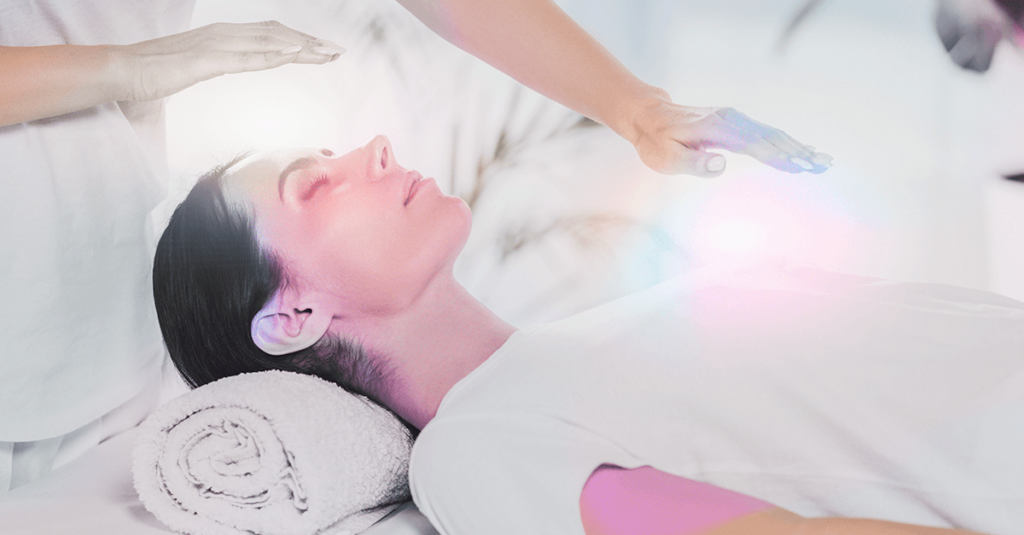
Originating in Japan in the late 1800s, Reiki is a form of alternative therapy often referred to as energy healing. Advocates suggest that it interacts with energy fields surrounding the body, allowing universal energy to be transferred from the practitioner’s palms to the patient. This “laying on hands” technique is based on the unseen “life force energy” that flows within us, keeping us alive.
When this life force energy is high, we are better equipped to stay happy and healthy. If it’s low, we may become more susceptible to stress or illness.
The Many Benefits of Reiki: Mind, Body, and Spirit
Reiki creates an environment that supports the body’s healing process. As a holistic therapy, it positively impacts the mind, body, and spirit, fostering overall well-being. Many individuals turn to Reiki for relaxation, stress reduction, and as a complementary method alongside traditional medicine. Reiki practitioners can also use self-Reiki for personal healing and growth.
The Joyous Effects of Reiki
A Reiki treatment can feel like a blissful glowing radiance flowing through and around you. By treating the whole person, including body, emotions, mind, and spirit, Reiki creates an array of beneficial effects, such as relaxation, peace, security, and well-being.
Reiki is a straightforward, natural, and safe spiritual healing and self-improvement method. It can support the healing process of nearly every known illness and malady and works alongside other medical or therapeutic techniques to reduce side effects and promote recovery.
Reiki, the universal life force energy, offers a profound pathway to relaxation, stress reduction, and holistic healing. This comprehensive overview has provided insights into the nature of Reiki, its mechanisms, and the remarkable benefits it brings to those who experience its transformative power. While Reiki is not a substitute for medical treatment, it can be a valuable tool on your wellness journey, supporting your body’s innate ability to heal and rejuvenate.
Reiki For Everyone
Learning to use Reiki is a remarkably simple process. This ability is not taught in the conventional sense, but it’s transferred during a Reiki class via an “attunement” given by a Reiki master. This process enables the student to tap into an unlimited supply of life force energy to enhance their health and quality of life.
While spiritually rooted, Reiki is not a religion. It requires no dogma or belief system to learn and use Reiki. Available to everyone, Reiki works irrespective of your intellectual capacity or spiritual development. By putting you in touch with your spirituality, it enhances your experience of your religion without imposing an intellectual concept of it.
Mikao Usui, the founder of Reiki, recommended practicing certain ethical ideals to promote peace and harmony, universally relevant across all cultures. Reiki goes beyond just using energy; it requires an active commitment to self-improvement and acceptance of responsibility for your healing. Thus, Reiki presents a complete system for physical and spiritual wellness.
Experience the rejuvenating power of spiritually guided life force energy, feel the radiant love that is Reiki, and embark on your journey toward holistic health with us at MAD REIKI.
Leave a Reply